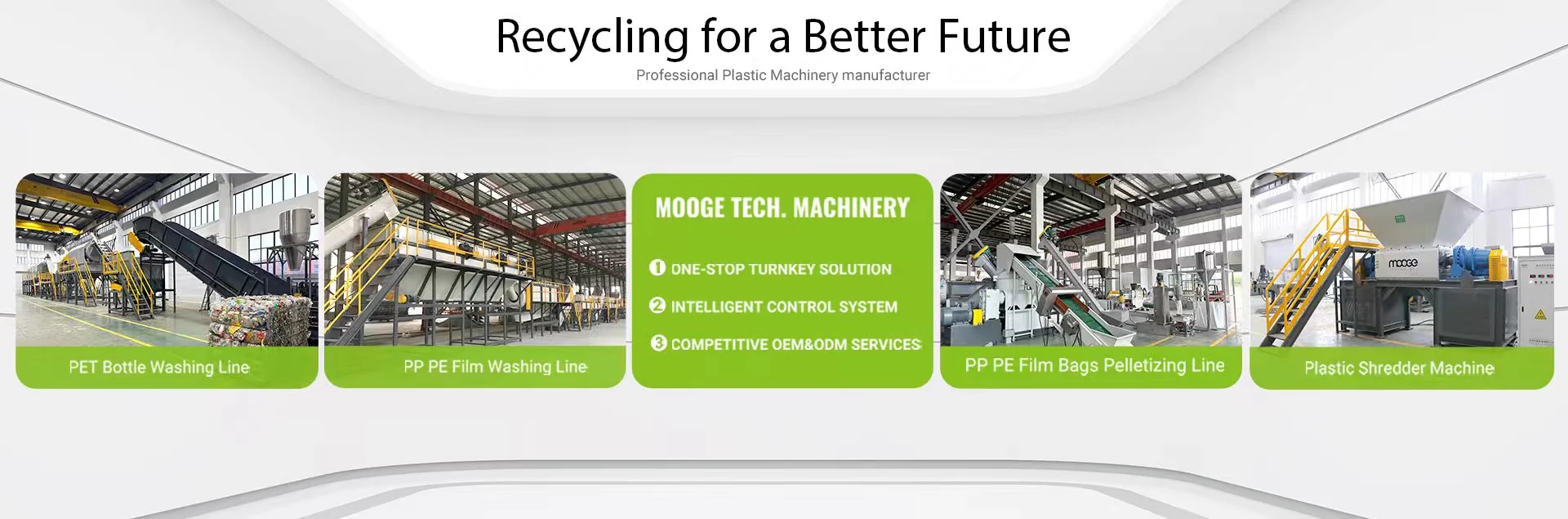
A PET bottle washing line runs only as well as it is fed. If bales reach the first machine unevenly, every machine after it works under pressure. That is why the
Steel Chain Conveyor sits at the very start of the MOOGE
PET Bottle Washing Line. It carries heavy, pressed PET bales to the
De-baling Machine at a steady pace.
This guide is for importers, distributors and recycling plant buyers. It explains what a
steel chain conveyor does, how it works and how it connects to the rest of the line. All machine details follow the MOOGE
R-PET Plastic Recycling Line product page, which covers input capacities from 500 to 5000 kg/h.
What Is a Steel Chain Conveyor in a PET Bottle Washing Line?

A
Steel Chain Conveyor is a heavy-duty feeding conveyor made of steel. In a PET recycling line, it is the first machine that handles the material. It takes in large, heavy bales of waste PET bottles and moves them continuously to the bale opener. The result is stable feeding at the start of the entire plastic washing line.
The line processes these materials:
- Waste PET bottles
- Water bottles and cola bottles
- PET sheet
- PET packing containers
These materials usually arrive pressed in bales. A bale is dense and heavy, so the machine that carries it must be strong. This is why machine number one in the 33-machine process flow uses a heavy-duty steel build.
Steel Chain Conveyor Working Principle: How It Loads Heavy PET Bales Continuously
The working principle is simple. The conveyor moves bales forward without stopping.
- PET bales arrive pressed and tied with steel wire.
- Workers manually cut off the steel wire.
- Workers push the bales onto the Steel Chain Conveyor.
- The conveyor carries the bales forward continuously.
- The bales reach the bale opener at a steady rate.
Because the conveyor loads bales one after another, the
De-baling Machine receives a constant flow, without gaps or sudden pile-ups. This steady rhythm sets the pace for every machine downstream.
Key Benefits for Buyers
- Continuous loading of large and heavy bales
- Stable feeding that supports the whole washing line
- A layout designed around your factory area
Tell us your bale size, weight and floor space, and our team will plan the layout with you.
Step 1: Steel Chain Conveyor and De-baling Machine for Bale Feeding and Opening
The
Steel Chain Conveyor feeds the
De-baling Machine. The
De-baling Machine has a rotating shaft made of wear-resistant steel. It breaks the pressed PET bales into loose pieces. This gives the next process a consistent material flow and lowers the risk of overload on downstream machines.
MOOGE offers a horizontal type and a vertical type.
Step 2: Trommel Machine and Pre-sorting Conveyor Belt for Removing Dirt and Large Waste
The
Trommel Machine loosens the PET bottles and removes coarse contaminants such as sand, dirt and small particles. Two chutes under its high platform let you place jumbo bags for easy waste collection.
Next, the
Pre-sorting Conveyor Belt carries the bottles past workers. They remove large waste such as film, paper, oil bottles and 5-gallon bottles. The belt is made of white PVC rubber, and its running speed is adjustable.
Step 3: High Speed Magnetic Conveyor and High Speed Bottle Washing Machine for Iron Removal and Bottle Cleaning
The
High Speed Magnetic Conveyor has a powerful magnetic roller on the belt. It removes iron and other ferrous pieces from the bottles automatically. This protects downstream machines and cuts breakdown time caused by scrap iron.
The
High Speed Bottle Washing Machine then scrubs the bottle surface. Its inside shaft runs at high rotary speed, while water jets spray the bottles. It removes surface dirt and improves cleaning efficiency. Choose a hot water or a cold water type.
Step 4: Label Remover Machine and Star Screen Machine for Separating Labels and Small Contaminants
The
Label Remover Machine uses specially designed rotary blades and fixed blades at high speed to scrape labels off the bottles. An air blower sucks the labels out and blows them into a label collecting silo.
The
Star Screen Machine separates small contaminants such as labels and dust. It has multiple parallel shafts fitted with star discs that rotate in the same direction. This creates a continuous vibration that shakes small contaminants out, so the next stage receives cleaner feed.
Step 5: High Speed Conveyor Belt, Optical Bottle Sorter and Manual Sorting Belt for Bottle Sorting
The
High Speed Conveyor Belt feeds the bottles to the sorter quickly and evenly. An even stream helps the
Optical Bottle Sorter separate bottles more accurately.
The
Optical Bottle Sorter uses high-resolution CCD cameras and image processing software. It tells PET bottles apart by color and material characteristics. Sorting accuracy by material or by color can reach 99%, which raises the purity of the final PET flakes.
The
Manual Sorting Belt adds a last visual check. Workers remove non-PET bottles, bottles of other colors and any visible waste. It uses white PVC rubber and an adjustable running speed.
Step 6: Automatic Metal Detector, Conveyor Belt and Material Divide Tee Chute for Safe Crusher Feeding

The
Automatic Metal Detector is a complete unit with its own conveyor and ejection system. When metal passes through, it ejects the affected bottles automatically, and the line does not stop. A touch screen with password control keeps operation simple.
The
Conveyor Belt then loads the bottles into the crusher. Its loading speed is adjustable. The belt is made of durable 10 mm rubber with a cleated pattern that stops bottles from slipping or rolling back.
The
Material Divide Tee Chute is Y-shaped or T-shaped. It directs material to two parallel crushers. When one crusher needs blade sharpening or replacement, the rest of the washing line keeps running. You can control it manually or by air cylinder.
Step 7: Plastic Crusher and Cold Water Sink-float Tank for Making Clean PET Flakes
The
Plastic Crusher cuts bottles into small PET flakes. High-speed rotary blades and fixed blades create a strong cutting action. Flake size is adjustable through the screen mesh, as the buyer requests. A water connection lets the machine crush with water, which reduces dust and starts washing the flakes.
To compare crusher options, see the MOOGE
Plastic Crusher/Grinder Machine range or read about the
SM-Series PET Bottle Crusher Machine, which covers models from 300 to 3000 kg/h.
The
Cold Water Sink-float Tank is filled with tap water. Rollers on the upper part wash the flakes and separate lighter contaminants such as PP/PE labels, caps and dirt. PET flakes sink to the bottom because of their higher density. A bottom screw conveyor then moves them to the next step.
Step 8: Hot Washing Tank, Auto Chemical Feeding System and Inline Water Circulation System
The
Hot Washing Tank removes glue, oil and dirt with hot water and chemical reagent. Paddles inside the tank tumble the flakes for thorough washing. Rockwool insulation holds the temperature, and a steam boiler heats the water to 80-90 degrees.
The
Auto Chemical Feeding System keeps the wash water at the right pH. A pH sensor checks the water online. When the pH drops, the controller starts the chemical pump to refill liquid caustic soda. It stops automatically when the pH reaches the set value.
The
Inline Water Circulation System supports the
hot washing tank. A compact vibration screen with fine mesh removes small impurities, and a water storage tank keeps the water circulating.
Step 9: High Speed Friction Washer Machine, Floating Washing Tank and Spraying Washer for Final Rinsing
The
High Speed Friction Washer Machine has a horizontal shaft with paddles that rotate above 1500 rpm. The flakes rub against the surrounding screen mesh while water sprays onto them, removing remaining dirt and chemical water.
The
Floating Washing Tank rinses the flakes with clean tap water. It washes off leftover caustic soda, surfactants and dissolved impurities. MOOGE suggests two or three sets in series for a better washing effect.
The
Spraying Washer is the final washing unit. Two rows of high-pressure spray nozzles flush away residual chemicals and micro-fine particles.
Step 10: Waste Water Treatment, Horizontal Spin Dryer and Hot Air Drying System
A PET washing line produces a large amount of waste water every day. MOOGE suggests a complete
Waste Water Treatment system with flocculation, chemical reaction, dissolved air flotation and a sand filter, so you can reuse the water. Share your local discharge rules when you request a quotation.
The
Horizontal Spin Dryer removes surface moisture with centrifugal force. At 1500 rpm, moisture leaves through the screen holes while the flakes stay inside. It lowers surface moisture from 20-30% to about 2-3% in a single pass.
The
Hot Air Drying System finishes the job. A heating box, air blower, air venturi and air piping convey the flakes in hot air, heated by electricity, thermal oil or steam, which speeds up evaporation of the remaining moisture.
Step 11: Magnetic Box Deferrization, Zig-zag Air Classifier and Straight Vibrating Screen for Flake Purification
The
Magnetic Box Deferrization uses strong permanent magnets to remove the last ferrous fines from the PET flakes before bagging. This keeps the finished flakes virtually free of ferrous material.
The
Zig-zag Air Classifier uses airflow to separate light contaminants such as dust, fines and labels from the heavier flakes through a zig-zag channel. Operators adjust the airflow by frequency.
The
Straight Vibrating Screen is inclined and typically uses 3 mm screen holes, or a size you customize. Vibratory motors screen out small PET fines, which improves the uniformity and bulk density of the final flakes.
Step 12: Color Sorter Machine, Polymer Sorter Machine and Eddy Current Machine for Final Quality Control
The
Color Sorter Machine uses CCD or CMOS optical sensors with high-intensity LED lighting. It reads color data from the top and bottom of the falling flake stream. Sorting accuracy is above 98%.
The
Polymer Sorter Machine uses a near-infrared (NIR) system. It identifies PET flakes and tells them apart from PE, PP, PVC, PS and PA.
The
Eddy Current Machine is the final metal-sorting safeguard. It uses electromagnetic induction to remove aluminum and other non-ferrous contaminants, which improves the quality of the finished PET flakes.
Step 13: Double Pneumatic Bagging Station and Electric Cabinet for Packing and Line Control
The
Double Pneumatic Bagging Station has two stations. Hooks hold the bags, and an air cylinder shakes them while the flakes pack. A time controller keeps operation easy.
The
Electric Cabinet controls the whole line on and off. You can choose a PLC control touch screen, which lets operators monitor, control and optimize the process in real time.
The line delivers clean, dry, fiber-grade PET flakes at about 99.5% purity and 1% moisture, ready for polyester staple fiber, PET sheets or PET straps.
MT-Series PET Bottle Washing Line: Main Parameters

The MT-series covers six standard models from 500 to 5000 kg/h. The line can be designed according to your actual factory area and final product requirements.
| Model |
Capacity |
Installed Power |
Steam Use |
Water Supply |
Manpower |
Area Required |
| MT-500 |
500 kg/hr |
180 KW |
200 kg |
4-5 m3/hr |
4-6 Person |
60*3.5*6 m |
| MT-1000 |
1000 kg/hr |
260 KW |
300 kg |
5-7 m3/hr |
8-10 Person |
80*5*6 m |
| MT-2000 |
2000 kg/hr |
400 KW |
500 kg |
10-15 m3/hr |
10-12 Person |
100*6*7 m |
| MT-3000 |
3000 kg/hr |
600 KW |
750 kg |
15-20 m3/hr |
12-16 Person |
120*8*7 m |
| MT-4000 |
4000 kg/hr |
800 KW |
1000 kg |
20-30 m3/hr |
15-20 Person |
160*8*7 m |
| MT-5000 |
5000 kg/hr |
1000 KW |
1200 kg |
30-40 m3/hr |
15-20 Person |
175*8*7 m |
What to Check Before You Request a Quotation
- Confirm the model, the input capacity and your target output in kg/h.
- Decide between a hot water or a cold water High Speed Bottle Washing Machine.
- Choose a horizontal or a vertical De-baling Machine.
- Compare power, steam, water supply and floor space with the table above.
- Ask for the certificates you need. The MOOGE website lists ISO, SGS, CE and FDA NOL.
- Ask about installation and after-sales support. MOOGE states that it offers 24/7 technical support.
MOOGE is based in Zhangjiagang, Jiangsu, China. Its website lists 20+ years of R&D experience and an 11000 m2 standard workshop.
FAQ: Steel Chain Conveyor and PET Bottle Washing Line
What does a Steel Chain Conveyor do in a PET bottle washing line?
It loads large, heavy PET bales continuously and feeds them to the bale opener. This gives the whole washing line a stable start.
What capacity can the MOOGE PET bottle washing line handle?
The MT-series covers input capacities from 500 to 5000 kg/h, from the MT-500 to the MT-5000 model.
Can I customize the line?
Yes. MOOGE designs the line around your factory area and final product requirements. Options include a hot or cold water bottle washing machine and a horizontal or vertical
De-baling Machine.
What final product does the line produce?
It produces clean, dry, fiber-grade PET flakes at about 99.5% purity and 1% moisture. You can use them for polyester staple fiber, PET sheets or PET straps.
What information do you need to prepare a quotation?
Please share your material type, target kg/h, factory area, final flake use, local power, water and steam conditions, and destination country.
Conclusion: Start Your PET Washing Line with a Reliable Steel Chain Conveyor
The
Steel Chain Conveyor looks like a simple machine, but it sets the rhythm of the whole PET bottle washing line. It loads heavy bales continuously, feeds the
De-baling Machine steadily and protects every stage that follows.
Every plant is different, so the right setup starts with your material and target output. For product details, a quotation, customization advice or technical support, email sales@moogetech.com or message MOOGE on WhatsApp at +86 13584489215.