Plastic waste keeps growing faster than most recycling facilities can process it, and buyers around the world are under pressure to find equipment that turns that waste into clean, sellable pellets. If you are sourcing a
waste plastic recycling line for the first time, or replacing outdated equipment, the choice of supplier matters as much as the machine specification itself.
MOOGE Machinery designs and manufactures complete
waste plastic recycling lines for PET, PE, PP, HDPE and other common resins. This guide explains how a recycling line works, what to look for before you order, and how MOOGE supports international buyers from first inquiry to after-sales service.
What Is a Waste Plastic Recycling Line?

A
waste plastic recycling line is a set of connected machines that sorts, cleans, shreds, washes, dries and pelletizes plastic waste so it can be reused as raw material. Instead of buying a single machine, buyers typically order a full line so that dirty, mixed plastic waste goes in one end and clean recycled pellets or flakes come out the other.
A typical
waste plastic recycling line includes a feeding system, a shredder or crusher, a washing and dewatering section, a drying unit, and either a pelletizing extruder or an agglomerator, depending on whether the output is pellets or dense flakes.
How Does a Waste Plastic Recycling Line Work?
Every
waste plastic recycling line follows the same basic logic, even though the machine configuration changes with the material. The waste is reduced in size, contaminants are removed, moisture is taken out, and the clean material is either melted into pellets or compacted into flakes.
- Feeding: bales or loose waste are fed into the line manually or by conveyor.
- Size reduction: a shredder or crusher cuts the material into smaller, uniform pieces.
- Washing: hot or cold washing tanks and friction washers remove dirt, labels, glue and food residue.
- Separation: sink-float tanks separate plastics by density, for example PET from PP caps.
- Dewatering and drying: centrifugal dryers and hot-air dryers reduce moisture to below 1%.
- Pelletizing or agglomeration: an extruder melts and filters the material into uniform pellets, or an agglomerator compacts film into dense flakes.
Waste Plastic Recycling Line for PET, PE, PP & HDPE
Material type is the single biggest factor in line design. PET bottles, PE film, PP rigid parts and HDPE containers all behave differently during washing and melting, so the machine layout and screen mesh, temperature settings and screw design need to match the input material.
For PET bottles, buyers typically choose a dedicated
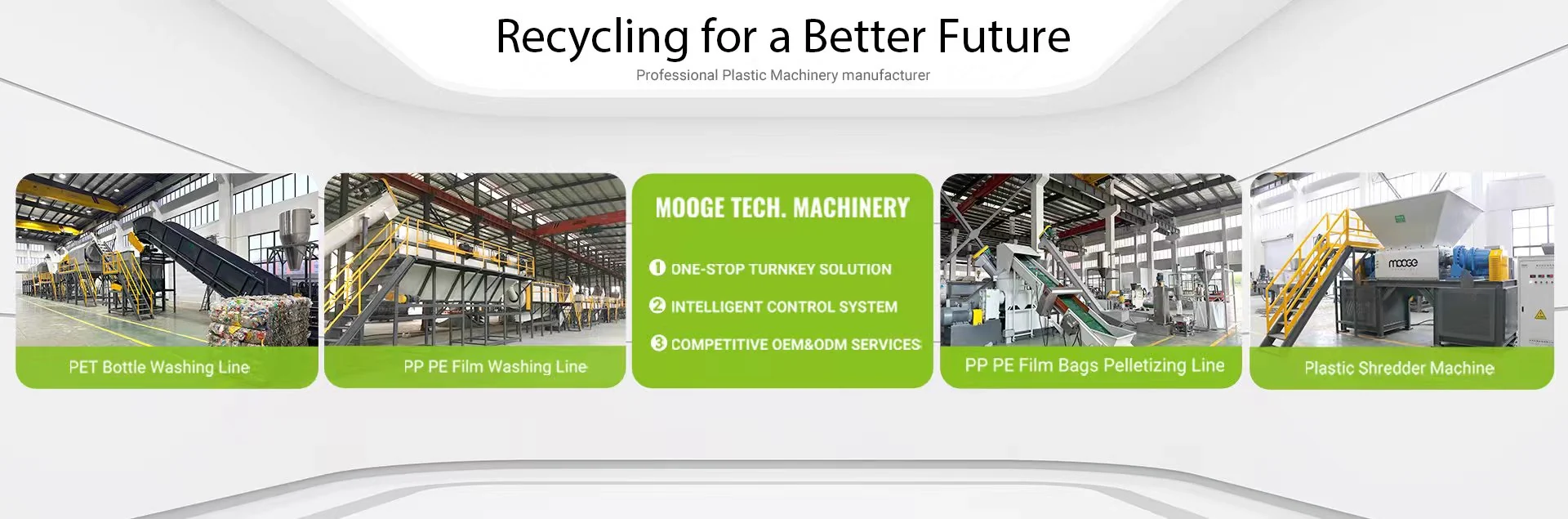
PET Bottle Washing Line that includes bottle sorting, label removal, hot washing and flake drying, producing clean PET flakes suitable for fiber, strap or bottle-grade pellet production.
For soft materials such as agricultural film, packaging film and woven bags, a
PE/PP Film/Bags Recycling Line handles the lower bulk density and higher moisture content typical of film waste.
HDPE and rigid PP parts, such as bottles, crates, pipes and household items, usually run on a rigid recycling line built around heavier-duty crushers and washing tanks that can handle thicker-walled material.
Types of Waste Plastic Recycling Lines We Supply
MOOGE builds several
waste plastic recycling line configurations, each suited to a different waste stream. Buyers can order a single machine, a partial line, or a complete turnkey system.
- PET Bottle Washing Line – for post-consumer PET bottles and preforms.
- PE/PP Film/Bags Recycling Line – for agricultural film, packaging film, and woven bags.
- PE/PP/PS/ABS Rigid Recycling Line – for rigid containers, crates, and household plastic waste.
- Plastic Pelletizing Line – for converting clean flakes or regrind into uniform pellets.
- Plastic Shredder Machine – for primary size reduction of bulky or thick-walled plastic waste.
- Plastic Crusher/Grinder Machine – for secondary size reduction before washing.
- PET/PP Strap Production Line – for converting recycled PET or PP into packing strap.
Waste Plastic Recycling Line Process: Sorting to Pelletizing

Sorting and Pre-Washing
Manual or semi-automatic sorting removes non-plastic contamination before the material enters the shredder. Pre-washing at this stage reduces wear on downstream equipment.
Crushing and Size Reduction
A shredder or crusher reduces bales and bulky items into consistent pieces, typically 10 to 25 millimeters, which is the size most washing and drying equipment is designed to handle.
Hot Washing and Friction Cleaning
Hot washing tanks combined with friction washers remove oil, labels, glue and organic residue. This step has the biggest impact on the purity of the final pellet, and washing time is usually adjusted based on how contaminated the input material is.
Drying and Dewatering
A centrifugal dryer removes surface water, followed by a hot-air or mechanical dryer that reduces internal moisture. Low moisture content is critical for stable pelletizing and for meeting buyer specifications on the recycled material.
Pelletizing
The dried flakes are fed into a single-screw or twin-screw extruder, melted, filtered to remove remaining impurities, and cut into pellets, either by strand-cut or underwater die-face cutting, depending on the resin and output requirements.
Key Machines in a Complete Recycling Line
A full
waste plastic recycling line is built from several core machines working together. Understanding what each one does helps buyers evaluate quotations and compare configurations from different suppliers.
Plastic Shredder Machine – handles primary size reduction of bulky, thick, or mixed plastic waste before it reaches the crusher or washing stage.
- Crusher/Grinder – reduces pre-shredded material into smaller, washable pieces.
- Washing tank and friction washer – clean surface dirt and separate labels or glue.
- Sink-float separation tank – separates plastics by density for material purity.
- Centrifugal dryer – removes surface moisture after washing.
- Hot-air dryer – reduces internal moisture before pelletizing.
- Pelletizing extruder – melts, filters and pelletizes the clean material.
- Auxiliary equipment – conveyors, dust collection, water treatment and control cabinets.
Waste Plastic Recycling Line Capacity & Output Options
Capacity requirements vary widely depending on how much waste a buyer processes each day and what the recycled material will be used for. Small workshops and pilot projects often start with lower-capacity lines, while large recyclers and municipal contractors need higher throughput and more automation.
MOOGE configures line capacity around the buyer's actual waste volume, available factory space, and target output, rather than offering a single fixed size. Sharing details such as input material, daily waste volume, and available floor space during the inquiry stage allows for a more accurate capacity recommendation and quotation.
Technical Specifications of MOOGE Recycling Lines
Below is a general overview of the specification ranges buyers typically compare when evaluating a
waste plastic recycling line. Exact figures depend on the material, capacity, and configuration selected.
| Specification |
Typical Range |
Notes |
| Input Materials |
PET, PE, PP, HDPE, PS, ABS |
Configuration varies by resin type |
| Capacity |
100 kg/h to several t/h |
Custom-built per buyer requirement |
| Output Form |
Clean flakes or pellets |
Depends on downstream extruder |
| Moisture Content (Output) |
Below 1% |
Achieved through dual-stage drying |
| Automation Level |
Semi-automatic to fully automatic |
PLC control available on request |
| Installation Support |
On-site or remote guidance |
Depends on project scope and location |
Why Choose MOOGE as Your Recycling Line Supplier
MOOGE has more than 20 years of research and development experience in plastic recycling machinery, backed by an 11,000 square meter standard workshop and a production and service team of over 100 people. The company holds 35 authorized technical patents, which reflects an ongoing focus on equipment design rather than only assembly.
Buyers can review the company's background, workshop photos and team information on the
About Us page before requesting a formal quotation.
Turnkey Waste Plastic Recycling Line Solutions
A turnkey
waste plastic recycling line covers more than the machines themselves. MOOGE supports the full project scope, including line layout planning, equipment manufacturing, factory testing, shipping documentation, installation guidance, operator training, and after-sales technical support.
For buyers setting up a new recycling facility, this turnkey approach reduces the coordination burden of sourcing machines from multiple vendors and helps keep the installation timeline predictable.
Certifications: ISO, CE, SGS & FDA NOL Compliance
MOOGE recycling equipment is manufactured under ISO quality management practices and holds CE and SGS certification, along with FDA NOL (No Objection Letter) recognition relevant to food-grade recycling applications. For buyers importing into regulated markets such as the EU or dealing with food-contact recycled material, these certifications are often a baseline requirement during supplier evaluation.
Waste Plastic Recycling Line Applications & Industries
Recycled plastic pellets and flakes produced by a
waste plastic recycling line feed into a wide range of downstream industries, which is why buyer requirements differ so much from one project to another.
- Packaging manufacturers producing new bottles, sheets, or films from recycled resin.
- Textile and fiber producers using recycled PET flake for polyester fiber.
- Agricultural film recyclers processing greenhouse and mulch film waste.
- Municipal and industrial waste management operators handling mixed plastic waste.
- Appliance and electronics recyclers processing ABS and PP housings.
- Strap and packaging material producers using recycled PET or PP.
Successful Projects & Global Case Studies

MOOGE regularly presents its
waste plastic recycling line solutions at international plastics and recycling exhibitions, including CHINAPLAS, GCPRS India, and Plast Alger, where the company has shown complete recycling systems to visiting buyers and industry partners. These events give overseas buyers a direct opportunity to see the equipment, discuss project requirements in person, and review real production examples before placing an order.
For project-specific references relevant to your material type and target capacity, the sales team can share configuration examples and discuss similar completed projects during the inquiry process.
Waste Plastic Recycling Line Cost & Factory Price
The cost of a
waste plastic recycling line depends on several factors: the input material, required capacity, level of automation, number of washing stages, and whether the buyer needs a complete turnkey system or individual machines. Because of this, a meaningful factory price can only be given after understanding the buyer's actual waste stream and production goals.
To get an accurate quotation, buyers are encouraged to share the following details when making an inquiry:
- Type of plastic waste (PET, PE, PP, HDPE, mixed, etc.)
- Approximate daily or monthly waste volume
- Desired output: flakes or pellets
- Available factory space and power supply
- Target market or end-use for the recycled material
Sharing this information upfront usually shortens the quotation process and results in a configuration that matches actual production needs rather than a generic package.
FAQs: Waste Plastic Recycling Line Buying Guide
1. What capacity should I choose for my first waste plastic recycling line?
Base the capacity on your actual daily waste volume, not on the largest machine available. Most first-time buyers start with a mid-range capacity that matches current supply and leaves room for future expansion.
2. Can one line process more than one type of plastic?
Some lines can handle multiple resins with adjustments to screen mesh, temperature, and screw configuration, but dedicated lines generally produce cleaner, more consistent output than shared lines processing mixed materials.
3. How long does it take to manufacture and ship a recycling line?
Manufacturing time depends on the scope of the order and current production schedule. The sales team can confirm an estimated timeline, including manufacturing, testing, and shipping, once the configuration is finalized.
4. Does MOOGE provide installation support outside China?
Installation guidance is available for international buyers, with the exact format, whether on-site or remote, depending on the project location and scope, agreed upon before the order is confirmed.
5. What information do you need to prepare a quotation?
At minimum, share the plastic waste type, approximate volume, desired output form, and available factory space. Photos or video of the current waste stream also help the engineering team recommend the right configuration.
6. Are the recycled pellets suitable for food-grade applications?
Suitability depends on the input material and the specific line configuration used. MOOGE equipment for food-grade applications is manufactured with FDA NOL compliance in mind, but final suitability should be confirmed against the buyer's target market regulations.
Conclusion
Choosing the right
waste plastic recycling line comes down to matching machine configuration with your actual waste stream, output goals, and budget, not just comparing headline capacity numbers. MOOGE works with international buyers to design lines around real production data, backed by over 20 years of manufacturing experience and ISO, CE, SGS, and FDA NOL certification.
If you are evaluating suppliers or ready to discuss your project, visit the
Contact page to send your waste material details and request a free quotation, technical consultation, or configuration recommendation from the MOOGE engineering team.